
spd_learn.models.TensorCSPNet#
- class spd_learn.models.TensorCSPNet(n_chans: int = 22, n_outputs: int = 4, n_patches: int = 4, n_freqs: int = 9, use_mlp: bool = False, tcn_channels: int = 16, dims: Tuple[int, int, int, int] = (22, 36, 36, 22), momentum: float = 0.1)[source]#
Bases:
ModuleTensor-CSPNet.
This class implements the Tensor-CSPNet model [Ju and Guan, 2023], an SPDNet framework for EEG-based motor imagery classification.
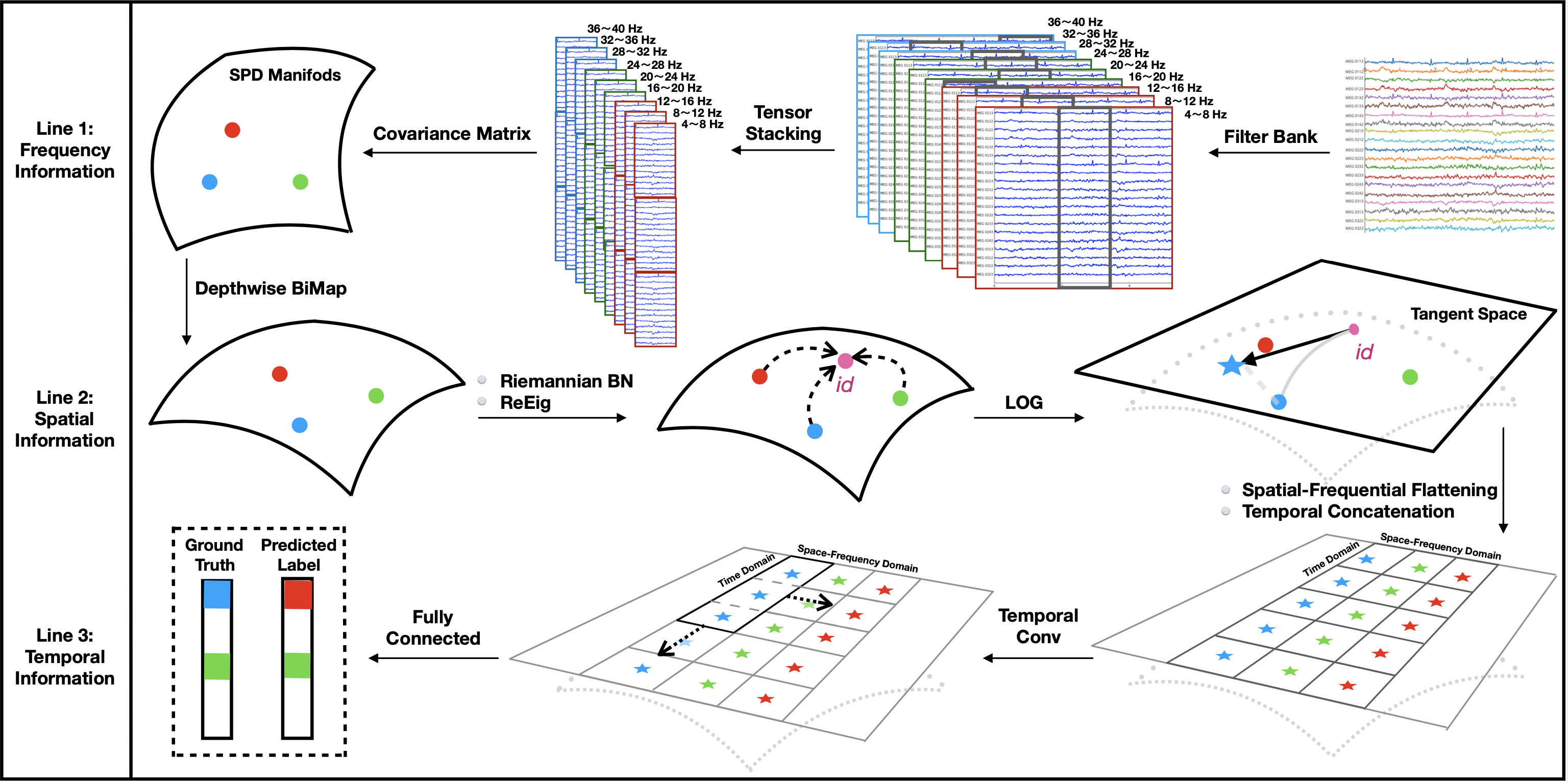
The architecture consists of four stages:
Tensor Stacking: Segments the EEG signals into temporospatial-frequency tensors.
Common Spatial Pattern (CSP): Uses modified SPDNet layers to capture spatial patterns.
Temporal Convolution: Captures temporal dynamics using 2D CNN layers.
Classification: Uses a linear layer or a multi-layer perceptron for final classification.
- Parameters:
n_chans (int, default=22) – Number of input channels.
n_outputs (int, default=4) – Number of output classes.
n_patches (int, default=4) – Number of patches to split the temporal dimension into.
n_freqs (int, default=9) – Number of frequency bands.
use_mlp (bool, default=False) – Whether to use a multi-layer perceptron in the final layer.
tcn_channels (int, default=16) – Number of channels for the temporal convolutional network.
dims (tuple[int, int, int, int], default=(22, 36, 36, 22)) – Dimensions for the BiMap layers.
momentum (float, default=0.1) – Momentum factor for the Riemannian Brooks Batch Normalization.
- forward(input: Tensor) Tensor[source]#
Forward pass of the TensorCSPNet model.
- Parameters:
input (torch.Tensor) – Input tensor of shape (batch_size, n_freqs, n_chans, n_times).
- Returns:
Output tensor of shape (batch_size, n_outputs).
- Return type: