
spd_learn.modules.LogEig#
- class spd_learn.modules.LogEig(upper=True, flatten=True, autograd=False, device=None, dtype=None)[source]#
Bases:
ModuleLogarithmic Eigenvalue Layer (LogEig).
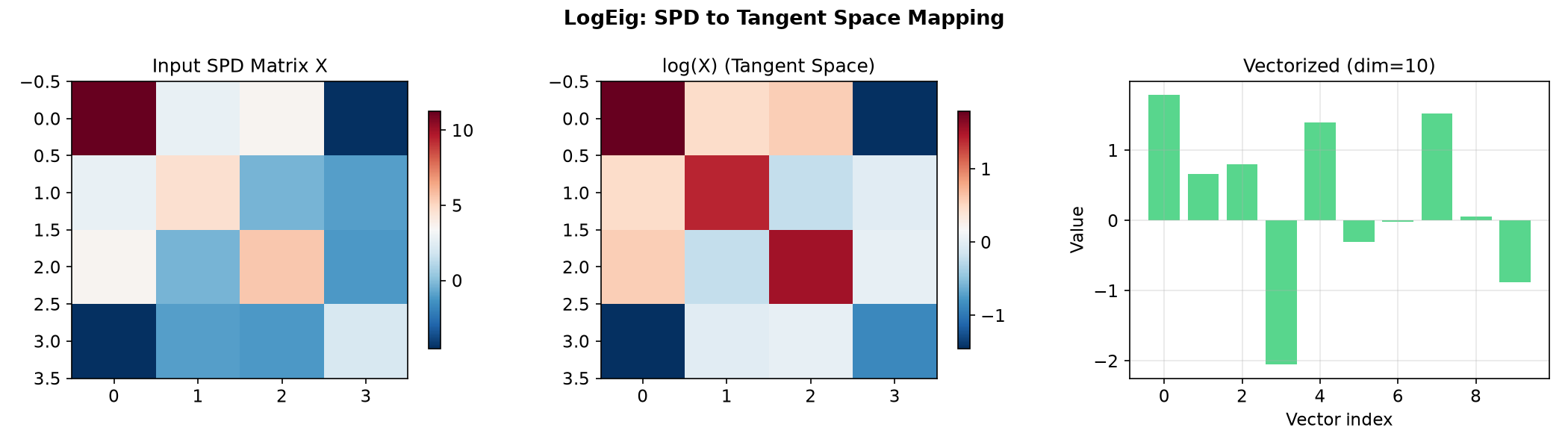
This layer maps SPD matrices to the tangent space at the identity via the Riemannian logarithm under the affine-invariant metric [Huang and Van Gool, 2017]. The output is then vectorized.
\[\log(X) = U \log(\Lambda) U^\top\]where \(X = U \Lambda U^\top\) is the eigendecomposition.
This operation embeds SPD matrices into the tangent space at the identity, which is a vector space, thereby enabling the use of standard Euclidean layers such as linear classifiers or fully connected networks for downstream tasks.
- Parameters:
See also
ExpEigInverse operation, maps from tangent space back to manifold.
ReEigEigenvalue rectification to ensure numerical stability before LogEig.
BiMapBilinear mapping for dimensionality reduction on SPD matrices.
matrix_log()Functional version of matrix logarithm.
log_euclidean_distance()Distance computation in log-domain.
Examples
>>> import torch
>>> from spd_learn.modules import LogEig
>>> layer = LogEig(upper=True)
>>> X = torch.randn(2, 4, 4)
>>> X = X @ X.mT + 0.1 * torch.eye(4)  # Make SPD
>>> Y = layer(X)
>>> Y.shape
torch.Size([2, 10])
import torch
import numpy as np
import matplotlib.pyplot as plt
from spd_learn.modules import LogEig

torch.manual_seed(42)

# Create a 4x4 SPD matrix
n = 4
A = torch.randn(n, n)
X = A @ A.T + 0.1 * torch.eye(n)
X = X.unsqueeze(0)

# Apply LogEig
logeig_full = LogEig(upper=False, flatten=False)
logeig_vec = LogEig(upper=True, flatten=True)

log_matrix = logeig_full(X)
log_vector = logeig_vec(X)

fig, axes = plt.subplots(1, 3, figsize=(14, 4))

# Input SPD matrix
ax1 = axes[0]
im1 = ax1.imshow(X[0].numpy(), cmap='RdBu_r', aspect='auto')
ax1.set_title('Input SPD Matrix X')
plt.colorbar(im1, ax=ax1, shrink=0.8)

# Matrix logarithm
ax2 = axes[1]
im2 = ax2.imshow(log_matrix[0].numpy(), cmap='RdBu_r', aspect='auto')
ax2.set_title(r'log(X) (Tangent Space)')
plt.colorbar(im2, ax=ax2, shrink=0.8)

# Vectorized output
ax3 = axes[2]
vec = log_vector[0].numpy()
ax3.bar(range(len(vec)), vec, color='#2ecc71', alpha=0.8)
ax3.set_xlabel('Vector index')
ax3.set_ylabel('Value')
ax3.set_title(f'Vectorized (dim={len(vec)})')
ax3.grid(True, alpha=0.3)

plt.suptitle('LogEig: SPD to Tangent Space Mapping', fontweight='bold')
plt.tight_layout()
plt.show()
- forward(X: Tensor) Tensor[source]#
Forward pass of the LogEig layer.
- Parameters:
X (torch.Tensor) – Input SPD matrix.
- Returns:
The vectorized output in the tangent space.
- Return type: