
spd_learn.models.TSMNet#
- class spd_learn.models.TSMNet(n_chans=None, n_temp_filters=4, temp_kernel_length=25, n_spatiotemp_filters=40, n_bimap_filters=20, reeig_threshold=0.0001, n_outputs=None)[source]#
Bases:
ModuleTangent Space Mapping Network (TSMNet).
This class implements the TSMNet model [Kobler et al., 2022], which combines a convolutional feature extractor, latent covariance pooling, an SPDNet, and a Tangent Space Mapping (TSM).
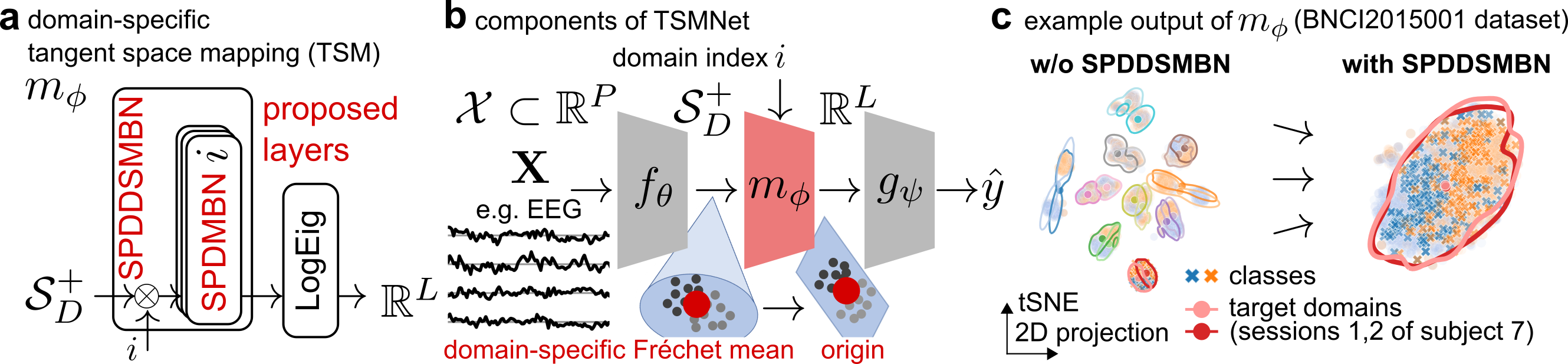
The model consists of the following layers:
A convolutional layer that applies the first two layers of ShallowConvNet [Schirrmeister et al., 2017].
A sample covariance matrix (SCM) pooling layer that creates SCMs from the convolved signals.
An SPDNet that includes a SPDBatchNormMeanVar layer before the LogEig layer.
A linear projection head.
- Parameters:
n_chans (int) – Number of input channels.
n_temp_filters (int, default=4) – Number of filters in the temporal convolution layer.
temp_kernel_length (int, default=25) – Length of the 1D kernels in the temporal convolution layer.
n_spatiotemp_filters (int, default=40) – Number of filters in the spatiotemporal convolution layer.
n_bimap_filters (int, default=20) – Number of filters in the BiMap layer.
reeig_threshold (float, default=1e-4) – Threshold for the ReEig layer.
n_outputs (int) – Number of output dimensions.
- forward(x: Tensor) Tensor[source]#
Forward pass of the TSMNet model.
- Parameters:
x (torch.Tensor) – Input tensor of shape (batch_size, n_chans, n_times).
- Returns:
Output tensor of shape (batch_size, n_outputs).
- Return type: